Wine retail often assumes more choice is automatically better. A bigger catalogue is supposed to signal deeper knowledge or better access. We do not see it that way. For us, the real question is whether you genuinely know the wines you are putting in front of people.
A tight range means every bottle was sourced deliberately, tasted more than once, and added only after we understood more than just the flavour. We want to know who made it, how the vines are worked, how the wine travels, and whether it still feels convincing over time. That level of attention takes focus. It does not scale well across hundreds of labels.
Terroir first
The first question we ask about any wine is whether it tastes like somewhere. Not a style, not a variety, not a price point. A specific place. A plot. A soil type. A microclimate that leaves a legible mark on the wine.
This eliminates a significant proportion of otherwise well-made wines. Wines blended from multiple sources to achieve a house style, wines made from high-yielding fruit on flattened land, wines designed for consistency across large volumes: these are fine products for their purpose, but they are not our purpose. What interests us is the wine that could only have come from one specific combination of site, vintage, and person. That specificity is what makes a bottle worth carrying.
The people behind the wine
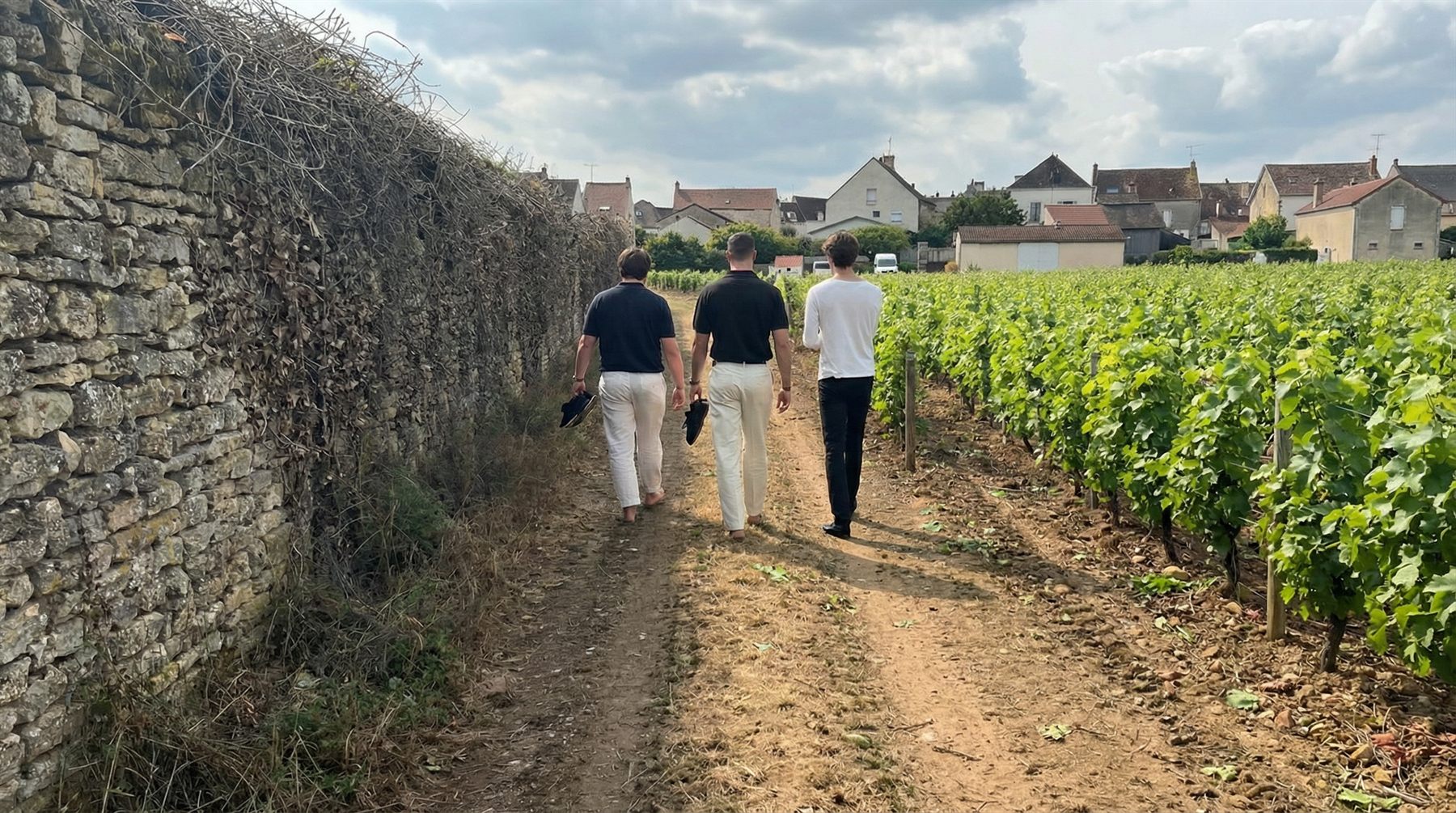
We visit producers before we list their wines. Not because the visit is ceremonial, but because the conversation that happens in a cellar or a vineyard reveals things that no tasting note can.
We want to understand how a producer thinks about difficult decisions. How they respond to a hard vintage. What they prioritise when commercial pressure and quality pull in different directions. These conversations, repeated across visits over years, build a picture of character that determines whether we can trust what is in the bottle.
We are also drawn to producers who are engaged with their land in a way that extends beyond the wine itself. Farmers who understand that the health of a vineyard is a long-term proposition, and who make decisions accordingly, tend to produce wines that reflect the same values: patience, integrity, and a refusal to take shortcuts.
Character over sameness
We have never added a wine to our selection because it was safe, or because it filled a gap in a category, or because it resembled something else in the portfolio.
Every wine in the range needs a real identity. Sometimes that comes from a grape few people are handling seriously. Sometimes it comes from a producer whose wines are immediately their own. A selection built this way will always have gaps, and we are fine with that. If we have not found the right grower in a style or region yet, we would rather leave the space open than fill it lazily. There are styles and regions we still do not cover because we have not yet found producers there whose work meets these standards. We are comfortable with those gaps.
"Every bottle in our catalogue has a reason for being there. If we cannot articulate that reason clearly, the bottle does not belong."
Reliability across vintages
A wine is not just its best vintage. We look at how a producer maintains quality when conditions are difficult, whether that means a frost-reduced harvest, a warm year that risked over-ripeness, or a wet September that required careful selection in the vineyard.
The producers in our selection have demonstrated that their standards hold across vintages. This does not mean every year is equally strong. It does mean each vintage shows its character honestly, and that the quality of the farming and the winemaking remains consistent even when the wine itself differs. We also control the import chain ourselves, because a great producer deserves an importer who takes logistics as seriously as the wine.
Exclusivity and accessibility, both
A portfolio of only rare and expensive bottles would serve a narrow audience and ask them to take all the risk. We are not interested in that.
We carry wines at different price points because we believe terroir expression and quality are available across a range of prices, and because our customers should be able to open a bottle on a Tuesday evening without feeling like they have broken something irreplaceable. We also carry wines that reward longer cellaring, for those who want that. The balance between these two poles is intentional. We want every customer to find something in the selection that is exactly right for what they are doing.
Why the portfolio stays small
We add wines carefully and remove them when something changes, whether that is quality, the supply chain, or our confidence in a producer's direction. We do not add wines to the catalogue and then leave them there because removing them is awkward.
The result is a selection that reflects our current thinking, our current relationships, and our current level of conviction. Nothing in it is there to pad numbers. Nothing is there because it was there before. That discipline, applied consistently, is what makes the catalogue worth trusting.
In de wijnhandel bestaat een hardnekkige aanname dat meer keuze beter is. Dat een breder assortiment diepere kennis, betere toegang of een groter publiek suggereert. Wij denken daar anders over, en dat verschil van inzicht gaat niet over moeilijk of exclusief willen zijn. Het gaat over wat het betekent om de wijnen die je verkoopt werkelijk te kennen.
Een compact assortiment betekent dat elke fles doelbewust is ingekocht, meerdere keren is geproefd, en pas aan de selectie is toegevoegd nadat wij niet alleen begrepen hoe hij smaakte, maar ook wie hem heeft gemaakt, hoe hij is geteeld, hoe hij aankomt en hoe hij zich in de loop van de tijd gedraagt. Dat niveau van kennis vereist tijd en focus. Het kan niet gelijkmatig worden verdeeld over tweehonderd wijnen.
Terroir eerst
De eerste vraag die wij stellen over een wijn is of hij ergens naar smaakt. Niet naar een stijl, niet naar een druivenras, niet naar een prijspunt. Een specifieke plek. Een perceel. Een bodemtype. Een microklimaat dat een leesbaar spoor achterlaat in de wijn.
Dit sluit een aanzienlijk deel van verder prima gemaakte wijnen uit. Wijnen die uit meerdere herkomsten zijn samengesteld om een huisstijl te bereiken, wijnen gemaakt van hoogproductief fruit op vlak land, wijnen ontworpen voor consistentie over grote volumes: dat kunnen degelijke producten zijn, maar het is niet waar wij naar zoeken. Ons interesseert de wijn die alleen maar voort kan komen uit één specifieke combinatie van plek, jaargang en maker. Juist die precisie maakt een fles het waard om te voeren.
De mensen achter de wijn
Wij bezoeken producenten voordat wij hun wijnen opnemen. Niet omdat het bezoek een formaliteit is, maar omdat het gesprek dat plaatsvindt in een kelder of wijngaard dingen onthult die geen proefnotitie kan.
Wij willen begrijpen hoe een producent met moeilijke beslissingen omgaat, hoe iemand reageert op een lastig jaar en wat voorrang krijgt wanneer commerciële druk en kwaliteit uit elkaar dreigen te lopen. Zulke gesprekken, gevoerd over meerdere bezoeken en meerdere jaren, geven een beeld van karakter. Dat bepaalt uiteindelijk of wij vertrouwen hebben in wat er in de fles zit.
Wij voelen ons bovendien aangetrokken tot producenten die op een manier met hun land omgaan die verder reikt dan de wijn alleen. Boeren die begrijpen dat de gezondheid van een wijngaard een werk van lange adem is en daar ook naar handelen, maken vaak wijnen die precies dat laten zien: geduld, integriteit en de discipline om geen snelle route te kiezen.
Karakter boven eenvormigheid
Wij hebben nooit een wijn aan onze selectie toegevoegd omdat hij veilig was, of omdat hij een gat in een categorie vulde, of omdat hij leek op iets anders in het assortiment.
Elke wijn in onze selectie heeft een specifieke identiteit. Die identiteit kan een druivenras zijn dat bijna niemand anders serieus mee bezig is, of een wijnmaakaanpak die resultaten oplevert anders dan waarvoor de regio bekend staat, of gewoon een producent met zo'n duidelijk standpunt dat de wijnen onmiddellijk en onmiskenbaar zichzelf zijn. Een assortiment dat zo is opgebouwd, zal altijd lacunes hebben. Er zijn stijlen en regio's die wij niet dekken omdat wij daar nog geen producenten hebben gevonden wier werk aan deze standaarden voldoet. Wij accepteren die lacunes.
"Elke fles in ons assortiment heeft een reden om er te zijn. Als wij die reden niet helder kunnen verwoorden, hoort die fles er niet in."
Betrouwbaarheid over jaargangen heen
Een wijn is niet alleen zijn beste jaargang. Wij kijken naar hoe een producent kwaliteit handhaaft wanneer de omstandigheden moeilijk zijn, of dat nu een door vorst gereduceerde oogst is, een warm jaar dat het risico van overrijpheid met zich meebracht, of een natte september die een zorgvuldige selectie in de wijngaard vereiste.
De producenten in onze selectie hebben laten zien dat hun standaarden standhouden over meerdere jaargangen. Dat betekent niet dat elk jaar even sterk is. Het betekent wel dat elk jaar oprecht zijn eigen karakter laat zien, en dat de kwaliteit van het werk in de wijngaard en kelder overeind blijft, ook wanneer de wijn zelf anders uitvalt. Daarom houden wij ook de importketen in eigen hand, omdat een geweldige producent een importeur verdient die logistiek net zo serieus neemt als de wijn.
Exclusiviteit en toegankelijkheid, beide
Een assortiment van alleen zeldzame en dure flessen zou een smal publiek bedienen en al het risico bij hen leggen. Dat interesseert ons niet.
Wij voeren wijnen op verschillende prijsniveaus omdat wij geloven dat terroir-expressie en kwaliteit beschikbaar zijn over een breed prijsspectrum, en omdat onze klanten op een dinsdagavond een fles moeten kunnen openen zonder het gevoel te hebben dat ze iets onvervangbaars openmaken. Wij voeren ook wijnen die langere flesrijping belonen, voor wie daar bewust naar zoekt. De balans tussen die twee polen is doelbewust. Wij willen dat elke klant iets in de selectie vindt dat precies past bij het moment.
Waarom het assortiment klein blijft
Wij voegen wijnen zorgvuldig toe en verwijderen ze wanneer er iets verandert, of dat nu kwaliteit is, de toeleveringsketen, of ons vertrouwen in de richting van een producent. Wij voegen wijnen niet toe aan het assortiment om ze daarna te laten staan omdat verwijderen ongemakkelijk is.
Het resultaat is een selectie die ons huidige denken, onze huidige relaties en ons huidige niveau van overtuiging weerspiegelt. Niets staat er om het aantal op te krikken. Niets staat er omdat het er eerder stond. Die discipline, consequent toegepast, is wat het assortiment het waard maakt om op te vertrouwen.